A System Within a System
Parallel Paths was an exhibition at Kiscell Museum in Budapest exploring Karl-Heinz Adler’s work and its connections to Hungarian abstraction. Planbureau developed a spatial concept based on repetition and geometric elements.
The modular installation used standard concrete formwork components to create partitions and display surfaces. It could be assembled and dismantled quickly, without fixing the structure to the floor. The components remained reusable after the exhibition.
Client
Industry
Product
Location
Timeline
Services
Kiscell Museum
Museum / Culture
Temporary Exhibition
Budapest, Hungary
3 months in 2017
Concept Development
Exhibition Design
Space Design


Abstraction Between Art and Architecture
Karl-Heinz Adler’s abstract art had limited visibility in the official East German art scene, while his geometric systems were widely applied in architecture and public space. The exhibition explored this contrast and its parallels with Hungarian abstraction.
The museum also needed a flexible installation that could be dismantled and rebuilt quickly, allowing the hall to accommodate other events during the exhibition period.


Designing with Adler’s Logic
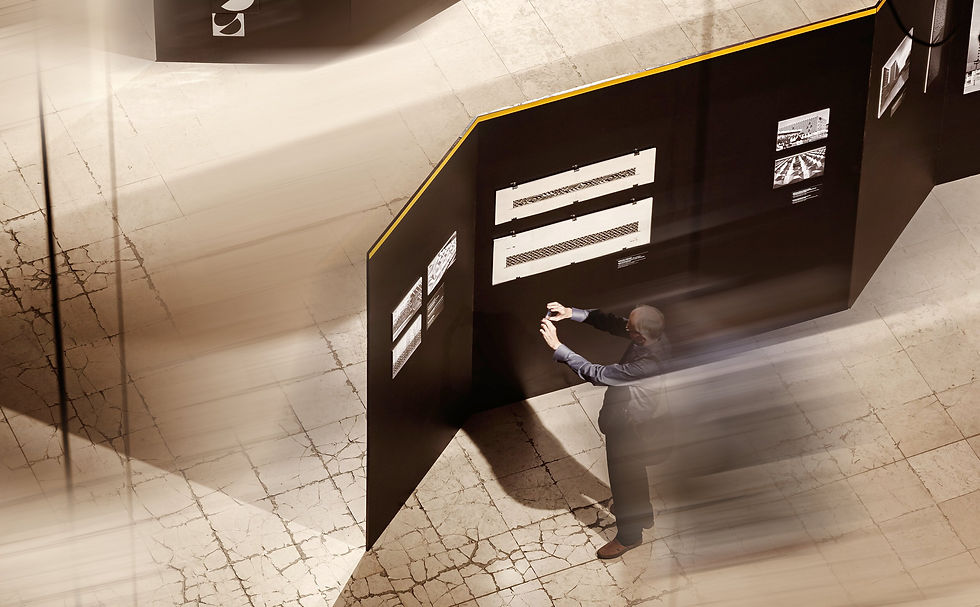
Adler created complex compositions through the repetition and variation of simple geometric elements. Planbureau translated this principle into a spatial system for the exhibition.
The challenge was to create stable, self-supporting partitions without fixing them to the floor. Standard concrete formwork elements were used without modification, enabling quick assembly and dismantling while preserving their future reuse.


A Space Built from Repeatable Elements
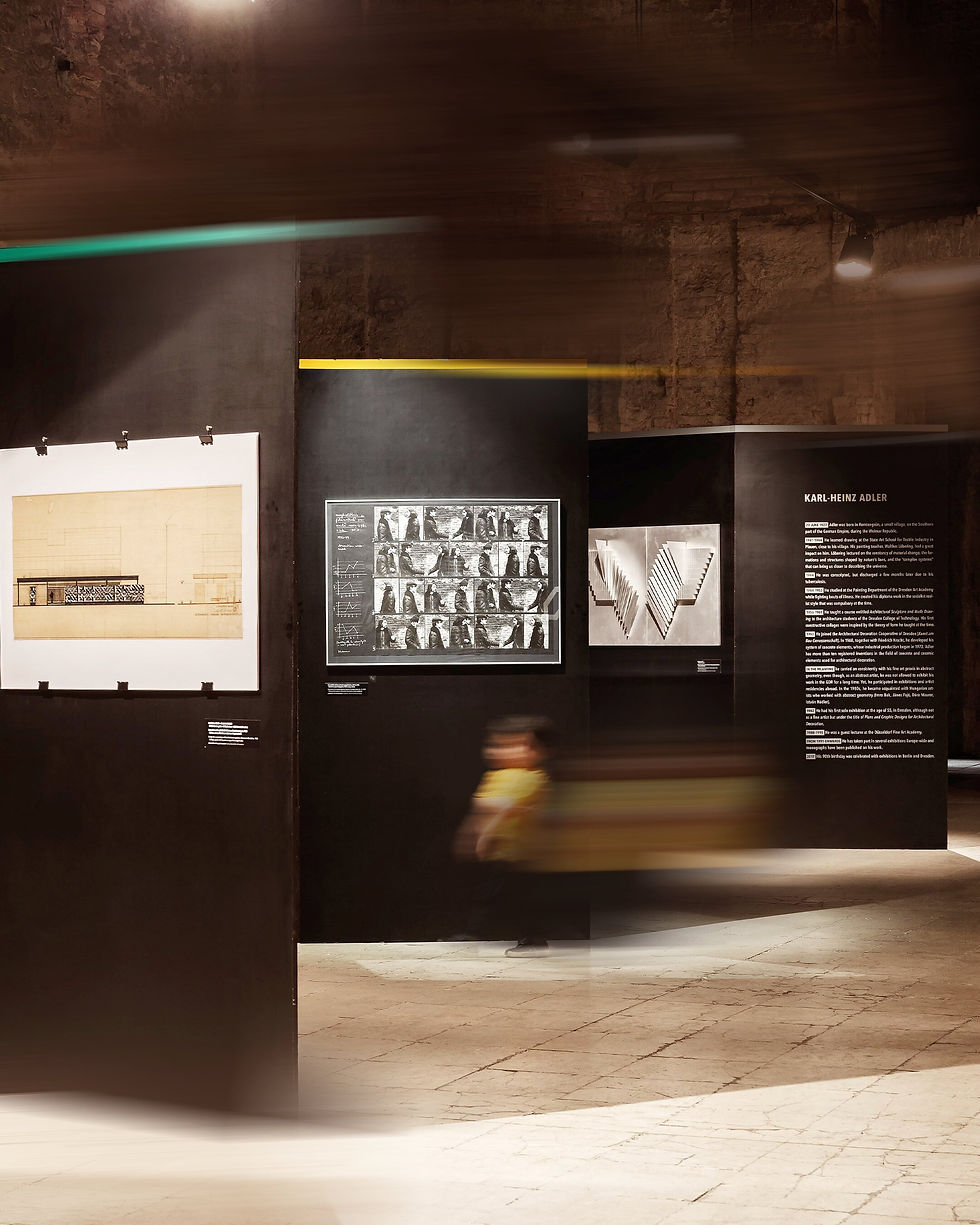
Planbureau developed a modular exhibition system using standard concrete formwork elements to create partitions, backdrops and spatial boundaries. The structure remained self-supporting and required no floor fixings.
The components could be assembled, dismantled and reused after the exhibition. Their repetition and variation shaped the space according to the same geometric principles found in Adler’s work, connecting the exhibition’s spatial design to its artistic subject.


Explore more

Logifaces